
Material

Engineering Plastics

High-performance polymers for insulation, low-friction and chemical resistance.

Material decision support

How this alloy behaves in your project.

Below is what we tell buyers about this alloy: where it pays for itself, where it costs you in cycle time or tooling, and which records to specify for shipment. Compare against your operating environment and tolerance stack before you finalize the print.

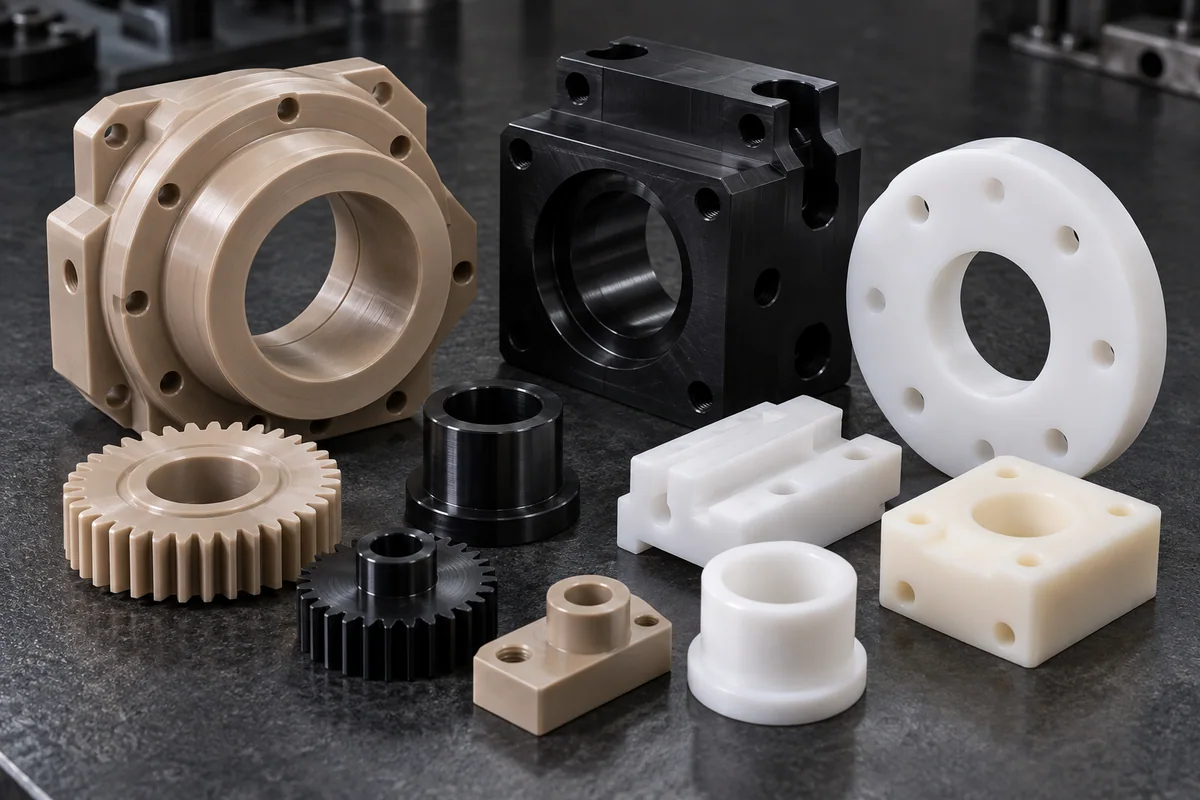
Engineering plastics for CNC-machined insulating components, sliding parts and lightweight fixtures. POM, PA, PTFE and PEEK differ in stiffness, moisture response, friction and temperature capability. Select the grade from the operating environment.

Reference grades

Grades to consider for Engineering Plastics

CodeNotes
ABSGeneral purpose — housings & enclosures
Acetal (POM-C, POM-H)Low friction — gears & bearings
Delrin (acetal homopolymer)Higher strength than copolymer
HDPEChemical resistance — tanks & liners
Nylon (PA6, PA66)Wear-resistant — bushings & gears
PEEKHigh-performance — aerospace & medical
Polycarbonate (PC)Impact-resistant — covers & shields
PTFE (Teflon)Chemical & temperature resistant
UHMWHigh wear — food-grade liners
ULTEM (PEI)Aerospace — FAA-flame-rated

Typical uses

Typical uses for Engineering Plastics

Electrical insulators & fixtures

For insulators and fixtures, specify POM, PA, PTFE or PEEK, moisture conditioning and dielectric notes. Plastics move with temperature and humidity.

Low-friction wear parts

For sliding parts, specify friction pair, PV load and whether lubrication is allowed. PTFE and POM are not interchangeable.

Chemical-resistant components

For chemical service, specify media, temperature and whether PEEK or PTFE is required. Do not substitute a cheaper plastic without approval.

How we work

Materials, tolerances, equipment

Engineering plastics for CNC-machined insulating components, sliding parts and lightweight fixtures. POM, PA, PTFE and PEEK differ in stiffness, moisture response, friction and temperature capability. Select the grade from the operating environment.

How should I select the grade?

POM, PA, PTFE and PEEK differ in stiffness, moisture response, friction and temperature capability. Select the grade from the operating environment. Material availability, stock size and certificate requirements are confirmed during quotation; a listed grade is not a stock guarantee.

What affects machining and inspection?

Review conditioning, thermal expansion, clamping distortion and dimensional stability. Functional tolerances depend on part geometry, material condition, fixturing and measurement method, not only the material family.

What should I specify for finishing?

State the finish standard, thickness, color or texture, masking and functional surfaces. Consider coating build in fits and threads. Approve any material or finishing substitution in writing.

Material quotation checklist

Send the exact grade and condition, 2D drawing, STEP model, quantity, critical features, service environment and traceability requirements. Tecpreva can review machining suitability and proposed alternatives before production.

Bring a drawing

Discuss your Engineering Plastics part with us.

Send the CAD file, required grade, quantity and operating conditions. We will review material availability and machining feasibility before confirming a production route and quote.

Request a quote